Unser Wissen ist ein kritisches Raten, ein Netz von Hypothesen, ein Gewebe von Vermutungen
Karl Raimund Popper, Logik der Forschung
When we onboard new clients, we often find problems with their existing network infrastructure
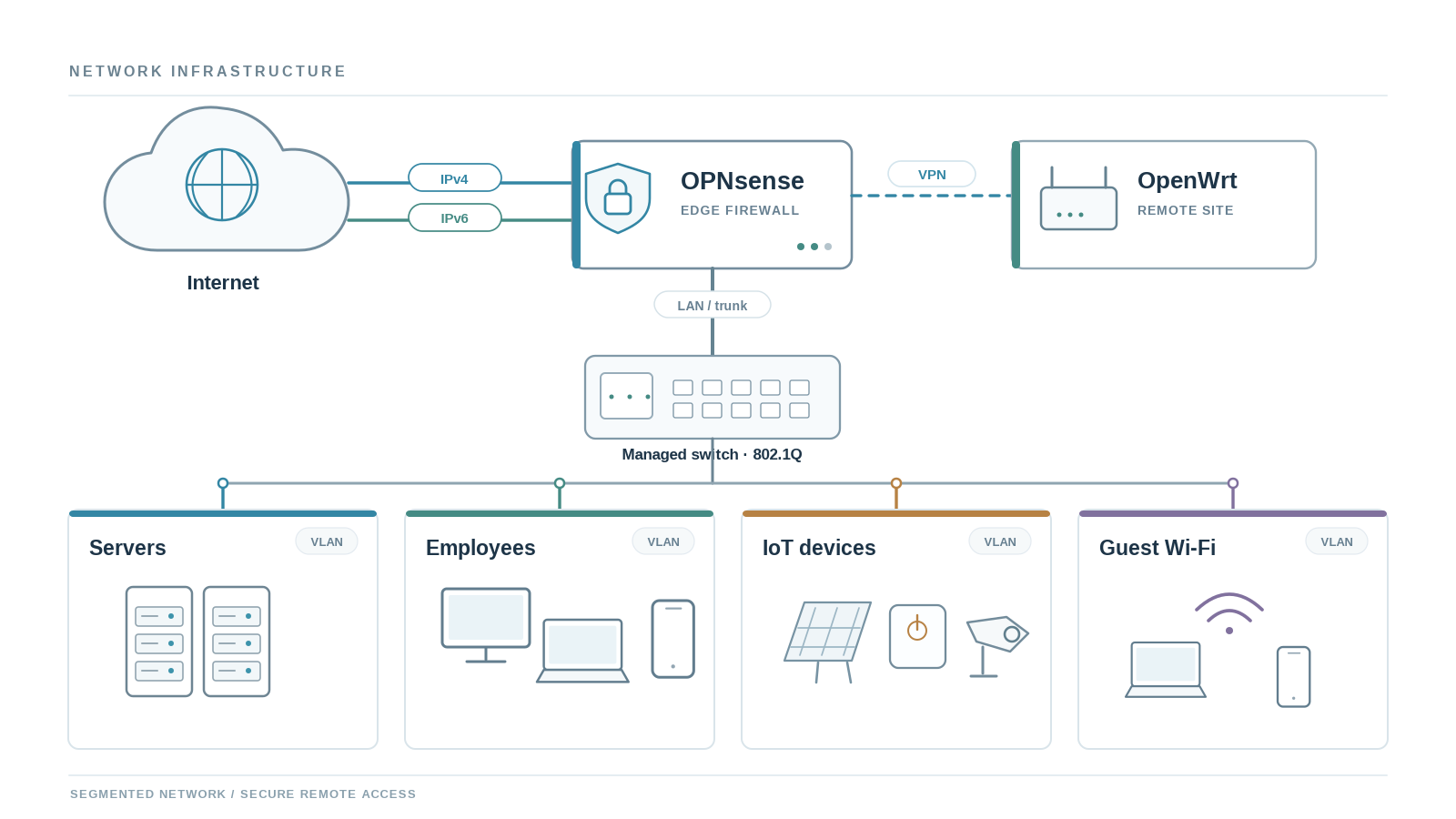
- The network is typically “flat”. The solar installation, phone system and other systems exposed to external attacks share a network segment with the company server that holds critical business data.
- The network has no IPv6 connectivity
- VPN access has serious security vulnerabilities
- The Wi-Fi network uses a shared password instead of WPA Enterprise, and that password hasn’t changed in years. Any former employee can still access all company data from the car park
When designing customer networks, we follow a set of fundamental principles and rely on proven technologies

VLANs Matter
Network Segmentation
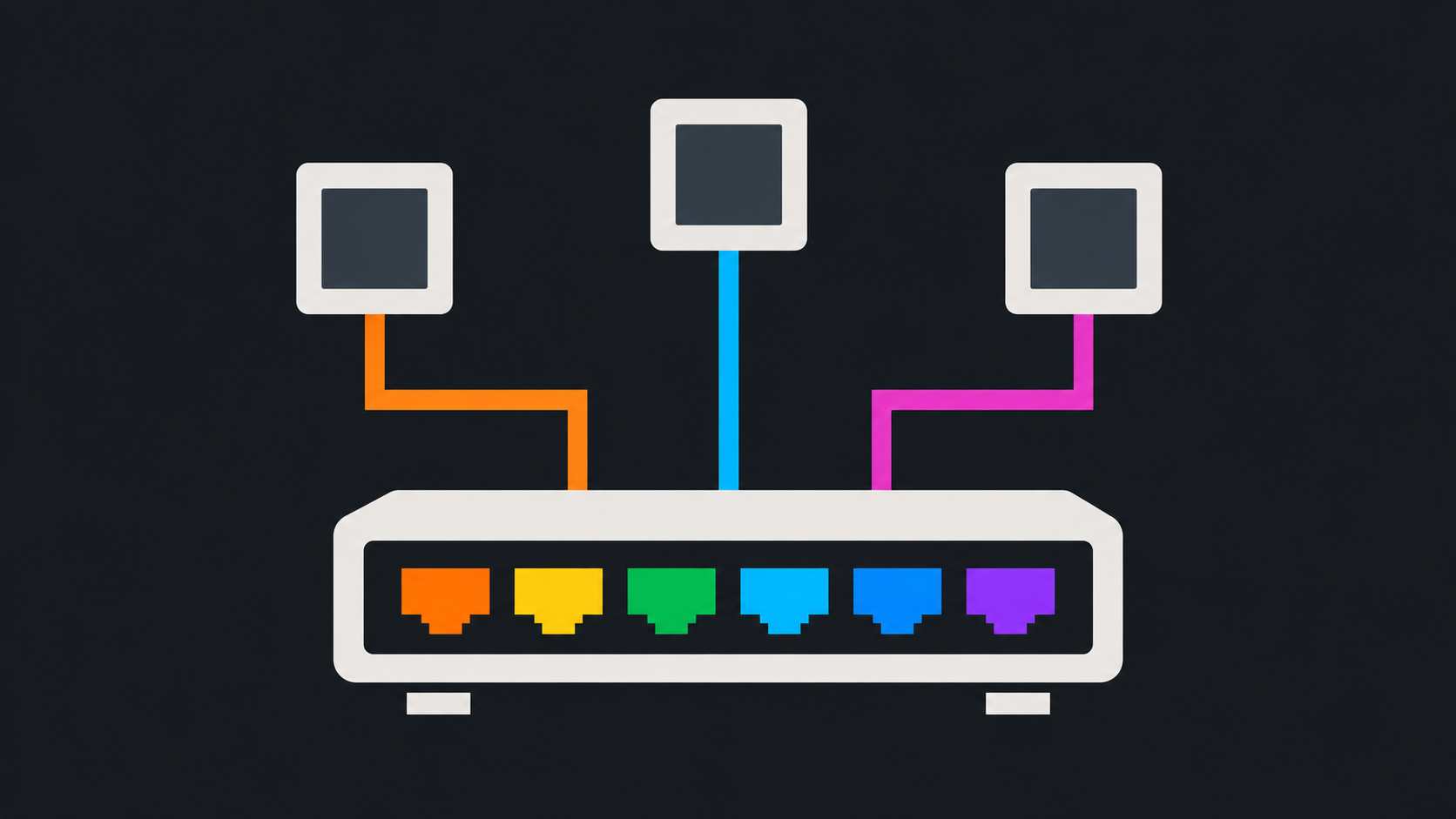
Putting all clients into a single network segment is generally no longer a good idea and is only acceptable from a security perspective in very small installations. Networks should be properly segmented across both wired and wireless connections, with clearly defined access permissions for each segment. Separating IoT devices from the rest of the network is becoming particularly important. Many of these devices like to "phone home", just as E.T. did back in the day, and may also be vulnerable to security exploits. We can help you design a network segmentation strategy that fits your environment like a tailor-made suit - neither too large nor too small.

Modern Internet Connectivity
IPv6
Unfortunately, IPv6 is still the neglected stepchild of the German IT landscape. Although more than 75% of all internet traffic is now carried over IPv6, IPv6 availability in corporate networks remains below 20%. In practice, this is already causing connectivity problems. Employees working from home may have native IPv6 connectivity with IPv4 merely provided through DS-Lite, while their company still operates an IPv4-only network. Unsurprisingly, the resulting VPN connections can be rather unreliable and performance leaves much to be desired. It is only a matter of time before internet services become available exclusively over IPv6.
As a matter of principle, we design new networks to pass the
(thanks to the Dutch for providing it!). Feel free to give it a try on your own company network.

Wireless Connectivity
Secure Wi-Fi Access
Your Wi-Fi signal doesn't stop at the walls of your building - chances are it can be received quite comfortably from the parking lot as well. A secure and sustainable Wi-Fi concept therefore relies on network segmentation and individual access permissions. Employees' personal smartphones have no business being on the corporate network. They are much better placed in a restricted guest network. Shared pre-shared keys (PSKs) are difficult to manage in larger environments, particularly when employees regularly join or leave the company. Instead, WPA-Enterprise should be used, providing individual access permissions and credentials for each user.
At the boundaries between network segments, and particularly at the network edge connecting to the internet, routing and firewalls become essential. For these purposes, we now rely almost exclusively on two proven open-source solutions that we know inside and out

Die vielseitige Edge-Firewall mit VPN
OPNsense
OPNsense is a free, proven, and highly versatile firewall distribution based on FreeBSD. We deploy OPNsense both as a gateway in clustered environments and in on-premises installations. So far, we have yet to encounter a firewall requirement from a customer that couldn't be implemented with OPNsense. For VPN connectivity with roaming users, we use OpenVPN and IPsec/IKEv2. For site-to-site connections, we prefer WireGuard, falling back to IPsec where WireGuard is not available.

Small, Lightweight and Flexible
OpenWrt
OpenWrt is a free, Linux-based firewall distribution. We use OpenWrt on a wide variety of hardware platforms for many different purposes: as a cloud gateway, for connecting smaller branch offices, and as a "travel router" for roaming users working from home or on the road.